Following in the footsteps of the (Part 3)
The Black Death
After Freddy Krueger and Zorro did not provide a good enough answer regarding the possibilities that many of those who experience sleep paralysis see the same character with the black cloak and wide-brimmed hat – you are welcome to hear my suggestion regarding the same character.
In the 14th century, Europe faced a terrible plague called the 'Black Death' that affected more than a third of the population, crushing society and throwing Europe into a very dark period that repeated itself several more times over the next hundreds of years with outbreaks of further plagues in the Middle Ages.
One of the characteristics of that period was a special role created by the church in which medical professionals attempted to treat sick people – often unsuccessfully. These people were called ‘plague doctors’.
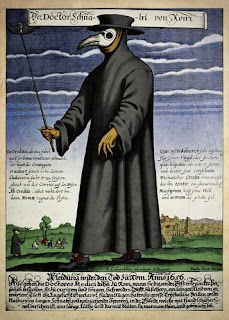
Medical professionals are supposed to symbolize hope and a ray of light, but in those years, according to evidence from that period, they mainly brought with them fear and terror. Their somber appearance consisted of black clothes, with a black cloak and a wide-brimmed black hat. In addition, starting in the 17th century, a mask resembling a bird's beak was added to their costume, containing fragrant herbs, a kind of early version of today's corona masks. Furthermore, the very appearance of a plague doctor in the city indicated that death was knocking on the doors of the residents.
The feelings conveyed by those doctors were accurately conveyed by Paul Forrest in a relief from 1656 (the image is attached to the post). In the background, children are seen running away from the doctor who is approaching them, and upon close examination of the main character, you can see that at the end of the cane is an hourglass with wings – symbolizing approaching death.
At the bottom of the relief is a kind of poem, a free translation of part of which reads as follows:
"...h